
Shopping Cart
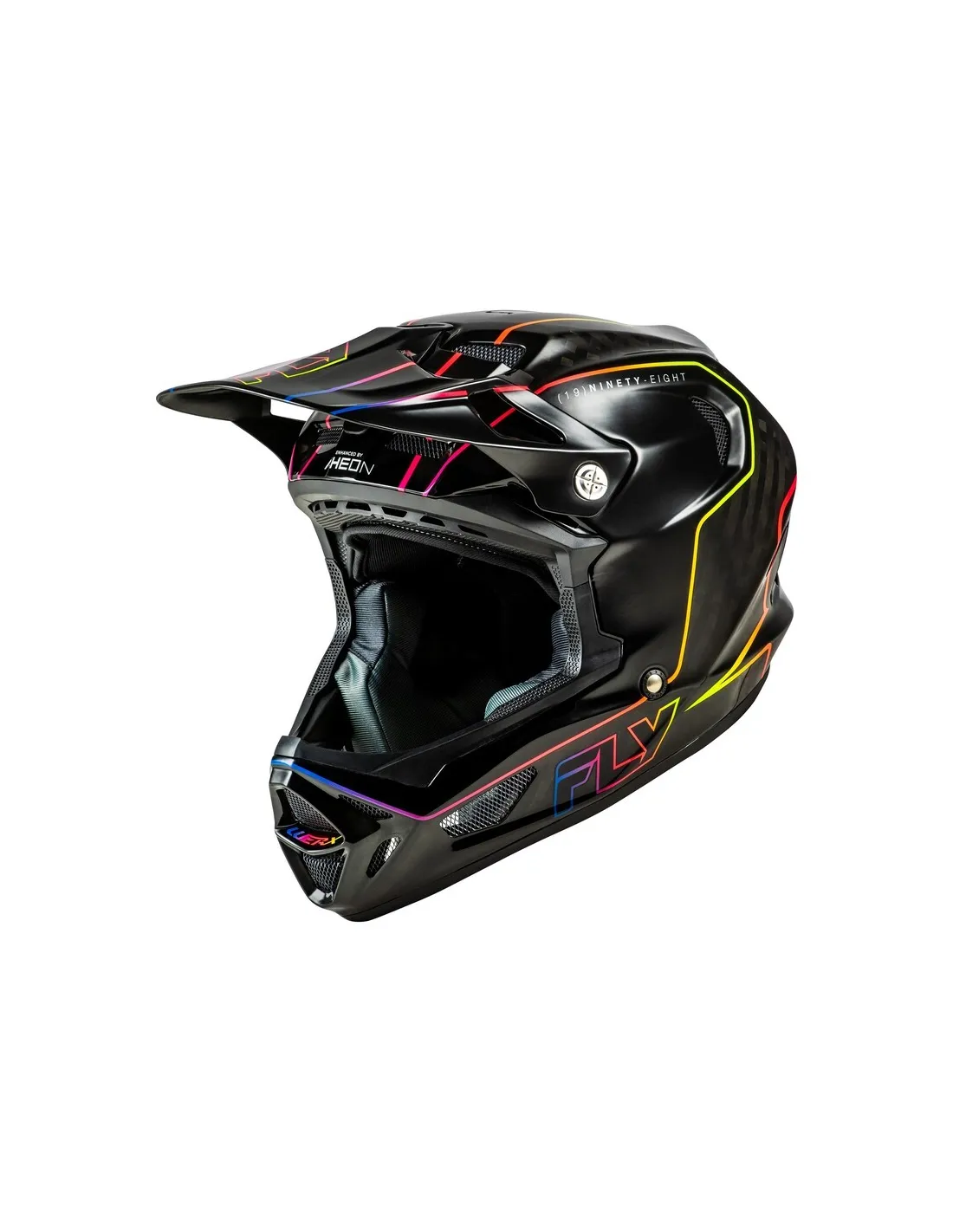


The full-face BMX race helmet is the one piece of kit made compulsory in competition. Here you will find race models certified to EN 1078 and ASTM F2032, in polycarbonate or composite shells, from a 48 cm junior head circumference up to adult XL, from Shot, Kenny, Fly Racing and Answer, with swappable cheek pads and spare peaks.


In BMX racing, a full-face helmet with a fixed chin bar is required by UCI rules and by the national federations for every moto and every supervised training session. It protects the skull, but also the face and jaw, the areas exposed when a rider goes down out of the gate or lands badly off a jump. An open-face lid, a removable chin bar or a skate helmet will not be accepted at the gate. UCI rule 6.1.081 also requires a peak at least 10 cm long: a full-face with no peak, or with a peak that is too short, is turned away at kit inspection just like a helmet without a fixed chin bar.
On the European market, a cycling helmet must carry the CE marking and meet EN 1078. Be clear about what that covers: EN 1078 certifies the shell, but it includes no chin bar test at all. A full-face described as "EN 1078 approved" therefore has no face protection certified by that standard. For that part, look additionally for ASTM F2032, the standard written specifically for BMX helmets, or ASTM F1952, the downhill mountain bike benchmark, which does add a chin bar strength test. The American CPSC 1203 standard, often listed alongside, is the regulatory equivalent of EN 1078 in the United States and tests the chin bar no further. Always check the label stitched inside the shell: that is what counts at kit inspection.
Measure the head circumference with a soft tape, about a centimetre above the eyebrows, and compare it with the brand's own chart: XS to XL equivalences vary noticeably from one maker to another. A correctly sized helmet does not move when you shake your head with the retention system fastened, and creates no pressure point on the forehead. Cheek pads and the inner liner come in several thicknesses to fine-tune the fit between two sizes.
Young riders usually start around a 48 to 52 cm head circumference. At that size, weight matters as much as protection: a heavy helmet tires the neck and unbalances the rider on the start hill. Go for a model designed as a junior helmet rather than a small adult size, and check both the length of the chin strap and where the buckle sits under the chin.
The peak is a replacement item after a crash: it is bolted on and comes off in seconds. Check its length while you are there, since the UCI requires a minimum of 10 cm (rule 6.1.081): a shortened or broken peak puts the rider outside the rules. Check the height of the eye port before choosing your BMX goggles, as not every lens fits every shell. Our BMX gloves and the rest of the kit sit in the BMX protective gear section.
A helmet is replaced after any impact, even with no visible crack: EPS crushes once and once only. In normal use, makers recommend renewal after three to five years, as the liner and shell age under sweat and UV. Clean the pads with warm soapy water, never with solvent.
As a multi-brand distributor, BMX RACING compares the size charts and the actual approvals — EN 1078, ASTM F2032, ASTM F1952 — of Shot, Kenny, Fly Racing and Answer rather than defending one catalogue. Send us the rider's head circumference and category, and we will point you to the models that genuinely fit. Dispatched within 24 to 72 hours, you can spread the cost over 2 or 3 payments.
A helmet is a beginner's first outlay: our article on getting into BMX racing places that cost among all the others.
A full-face helmet is mandatory: it protects the face and jaw in a crash. Choose the right size (head circumference) for a perfect fit, with no pressure points.
Measure your head circumference above the eyebrows and check it against the size guide. The helmet should stay put with the strap fastened, without painful tightness.
Yes: shipping is free within mainland France from €99 of purchase. Below that, the cost is shown at checkout according to weight and the chosen shipping method.
Absolutely. You can pay for your purchases in 2 or 3 instalments with Alma, completely securely. The option appears automatically at checkout.
You have 14 days after delivery to change your mind. The item must be new, unfitted and in its original packaging to be returned or exchanged.
Yes, we also ship to the French overseas territories (DOM-TOM). Times and costs depend on the destination and parcel weight; the exact amount is calculated and shown before you confirm your order.